Book Reviews
‹ previous | page one of one | next ›
-
Line Upon Line, Precept Upon Precept
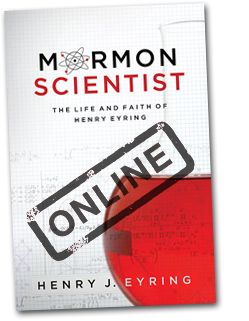
“You’ve got to write your grandfather’s story,” Elder Neal A. Maxwell explained to Henry Johnson Eyring on numerous occasions. Eyring felt that he was not capable of producing such a piece of work, but after much faith, determination, and research, we now have “Mormon Scientist”, the biography of world-renowned chemist and scientist Henry Eyring. Henry Eyring was a master of paradoxes, and as such, he was able to fuse science and his faith and membership in The Church of Jesus Christ of Latter-day Saints. Many see his paradoxical way of living and thinking as contradictory, but in reality, it made him a great bridge builder and a very powerful communicator. The book highlights the communication challenges that arise from extreme positions such as science-only or religion-only. In other words, the book’s theme is the trouble caused by ideas that seemed opposed and beg their adherents to disprove the seemingly opposing idea. The book describes how Henry was able to overcome these apparent rivals by being on both sides, seeing the truth in both.
The book clearly identifies Henry’s reasoning in believing both in religion and in science, even when they seemed to conflict. To put it short, Henry believed what scriptures teach when they say, “For behold, thus saith the Lord God: I will give unto the children of men line upon line, precept upon precept, here a little and there a little; and blessed are those who hearken unto my precepts, and lend an ear unto my counsel, for they shall learn wisdom; for unto him that receiveth I will give more; and from them that shall say, We have enough, from them shall be taken away even that which they have.” (2 Nephi 28:30) Henry believed that neither science nor religion is complete, so we don’t have all of the answers to the puzzle. He lived his life believing that both are compatible, but that what we know is most likely not the entire truth.
All in all, Mormon Scientist conveys the peculiar man who is Henry Eyring. Henry did many things that in most circumstances would seem like career suicide, such as leaving Princeton for the University of Utah, but by reading one comes to see how Henry was doing things for the greater good. By studying the book, the reader will have a greater understanding and appreciation of both religion and science and will be able to see that they literally are compatible.
-
Comments on the relationship of science & religion
On the Relationship of Science and Religion
While public perception is that a preponderance of scientists are atheists, the facts are otherwise. Dr. Eyring is far from alone in thinking that there is a spiritual dimension to reality and that a belief in God does not preclude the highest form of scientific thought.
Students of science — and otherwise — are entitled to know as part of their learning process that such great names as Eddington, Shrodinger, Jeans, Heisenberg, Hawking, Penrose, and Hoyle share this view, as did the great Alexander Graham Bell, Thomas Edison, and Nikola Tesla, the inventor of alternating current, the induction coil, micro-wave energy, and neon and fluorescent light. And to these names we must add the somewhat less familiar, but equally important name of Princeton University Professor Henry Eyring, developer of the mathematics which explains the otherwise mysterious quantum mechanics which dominates contemporary scientific thinking. Eyring was awarded every top prize in physics and chemistry with the exception of the Nobel Prize. He was nominated for the Nobel several times without success, many think because the Nobel jury prefers to award the prize to simple, straightforward discoveries in preference to more complex mathematical processes few can follow and even fewer comprehend. But Eyring’s work has provided explanations for hundreds of otherwise contradictory physical processes involving quantum mechanics.
Nor is it just scientists and mathematicians who have wondered at the inherent intelligence which evidently underlies existence: musicians like Chopin and Beethoven repeatedly said that their greatest compositions came into their minds in virtually completed form. Indeed, Beethoven had to hurry home from his walks along the Neckar River in order to write down the music he heard in his mind before he forgot it. All expressed the view that their greatest ideas arrived ready-made from some superior source. No “superstition”, let alone “religion”, in mentioning these facts to aspiring students of science. The thinking of these greats deserves to be taught more seriously than in a Sunday School class.
D. B. Timmins, PhD, Harvard
-
Reflections of a Scientist
I walked through the doors of the Henry Eyring chemistry building many times as a student at the University of Utah. I learned inorganic chemistry from Ted Eyring. Organic chemistry was also fascinating. Science became more than just memorizing laws and equations, but rather a way to learn the mysteries of the Universe. I have been humbled by it. As I struggled in my personal life, science became an anchor for me. I happened to read “Reflections of a Scientist” at a point in my life when I doubted the importance or relevance of faith. Looking back, I recognize the important role Dr. Eyring played in my decision not to ignore certain truths because of certain unknowns. I have found greater understanding and deeper love for the universe because of such books as “Reflections of a Scientist” and “Mormon Scientist”
-
Fusing Faith & Science
Henry Eyring fused science and religion. He never felt that his faith and profession were at odds. On the contrary, he felt that science enhanced his faith, and vice versa. I was not only impressed with Dr. Eyring’s profession of faith and science, but I was amazed at his level of active involvement in each of them. He led Mormon congregations and scientific organizations, gave faith-promoting talks and wrote ground-breaking scientific papers.
The organization of the book is refreshing for a biography. As the author says in the Introduction, “Rather than proceeding chronologically through his life, we’ll look first at the things he accomplished (his Legacy), then at the family experiences that shaped him (Heritage), and then at the unusual way he thought (Paradoxes). We will close with a section called Testament, in which Henry bears witness to those things of greatest importance.”
This book not only gives insight into the life and mind of a world-renonwned scientist, but proves that a person does not have to choose science or religion — both “disciplines” can be embraced.
‹ previous | page one of one | next ›